After living in the UK for a long time, my understanding of scarves has changed in a very obvious—and almost irreversible—way.
Before coming to the UK, scarves felt more like optional accessories. They were often used to add a bit of visual interest to an outfit when needed, and left forgotten in the corner of a wardrobe when not. When it was truly cold, people relied far more on thick coats, down jackets, or simply indoor heating.
But in the UK, scarves are an entirely different thing.
They are no longer just part of an outfit, but something deeply tied to climate, daily movement, and lifestyle. You quickly realise that scarves here are not a “bonus”—they are a functional item used almost every single day.
Cold weather in the UK is rarely about extreme low temperatures.
What truly wears you down is the long-term, repetitive, persistent damp cold.
In the morning, temperatures may hover just above freezing. You wait for buses in strong winds. After ten minutes of walking, your body warms up. Then you step indoors and have to adjust quickly to another temperature change. Throughout all of this, the scarf remains wrapped around the neck—one of the most wind-exposed yet hardest-to-regulate parts of the body.
Because of this, whether a scarf is practical, comfortable, and genuinely versatile matters far more than one might expect.
The Real Usage Frequency of Autumn/Winter Scarves Is Higher Than You Think
If you actually track what you wear during a British autumn and winter, you’ll notice something interesting:
Coats rotate.
Shoes change.
But scarves are often the same one or two pieces appearing again and again.
In London, scarves are worn almost daily throughout autumn and winter—not for styling purposes, but simply to cope with the weather.
- Leaving the house in the morning
- Standing at windy bus stops
- Walking to work
- Moving repeatedly between indoor and outdoor spaces
The scarf stays at the neck—the area most exposed to wind and least protected by outerwear.
This kind of high-frequency, long-term, almost unconscious use demands one essential quality from a scarf:
it must not demand attention.
A scarf that constantly needs adjusting, slips out of place, or feels too heavy or stiff will eventually become a burden.
Once a garment starts demanding your attention, it can no longer be truly versatile.
By autumn/winter 2025, I’ve noticed a very clear shift: people are choosing scarves more rationally, rather than blindly chasing seasonal trends.
Compared to previous years—when “statement design,” “visual impact,” and “presence” dominated—this season’s priorities have changed:
- Durability
- The ability to withstand repeated wear
- Compatibility with most outerwear in one’s wardrobe
- The potential to last across multiple winters
In other words, scarves are moving away from being trend items and back toward long-term essentials.
This doesn’t mean scarves matter less. Quite the opposite—it means their role within the wardrobe is being re-evaluated more seriously.
Scarves Are No Longer Decorative—They Are Structural Elements of Autumn/Winter Dressing
The overall direction of outerwear design for autumn/winter 2025 is very clear:
clean lines, restraint, and an emphasis on cut and proportion.
Whether it’s wool coats, down jackets, or tailored outerwear, decorative details are being reduced in favour of silhouette and construction.
This shift has a direct consequence: outfits become more timeless, but also more dependent on accessories to create depth.
This is where scarves come in.
A well-chosen scarf can shift the entire tone of an outfit without altering the coat itself:
- The same coat
- Different scarf materials
- Different colours or ways of wearing
The resulting styles can be completely different.
Formal or casual, office-ready or relaxed—the difference often lies in the scarf.
On the streets of London, I often see the same classic coat styled in entirely different ways simply through the choice of scarf. This is why I’ve become increasingly willing to invest time and budget in scarves that can truly be used long-term.
What Truly Determines Comfort Isn’t Thickness, but “Fit”
After trying many different scarves, I’ve come to one clear conclusion:
Whether a scarf is good has very little to do with how thick it is.
What really affects daily comfort is fit.
Fit doesn’t mean tightness. It refers to whether:
- The scarf moves naturally with the body
- It stays in place rather than slipping
- It avoids awkward bunching when walking or turning
- It doesn’t get stuck at certain angles, prompting constant adjustment
Many scarves that look warm and luxurious on display become distracting in real life. And any item that repeatedly draws attention to itself cannot be a true everyday piece.
The Details I Now Pay Attention To When Choosing Scarves
When selecting scarves for autumn/winter 2025, I deliberately focus on details I once overlooked:
- Width: too narrow offers little warmth; too wide causes bulk
- Length: should drape naturally without requiring a fixed tying method
- Edges: soft edges that don’t curl or distort
- Weight: comfortable enough for long periods of wear
Together, these factors determine whether a scarf feels like something that walks with you—or something that distracts you.
Gucci Wool and Cashmere Scarf
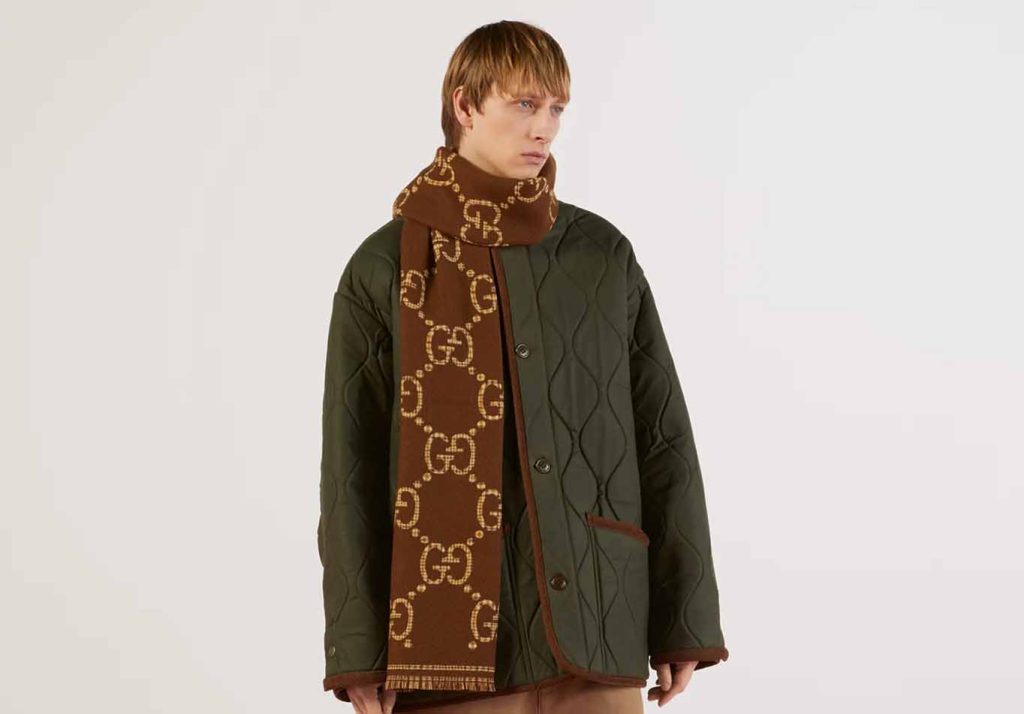
A Stable, Classic, Nearly Foolproof Choice
If I had to describe this scarf in one word, it would be: reliable.
Gucci’s wool-and-cashmere scarf for this season follows the brand’s restrained design language. It doesn’t try to dominate an outfit, nor does it rely on overtly seasonal motifs.
It may not stand out at first glance, but it becomes increasingly pleasing the more you wear it.
Long-Term Value of the Material
The blend of wool and cashmere is immediately noticeable in wear:
- Wool provides structure and shape
- Cashmere ensures softness and comfort
This combination allows the scarf to maintain its form even after repeated use.
In the UK’s damp climate, this balance is especially important. Pure cashmere, while soft, often loses shape; pure wool can feel too rigid. A thoughtful blend sits comfortably between practicality and refinement.
Styling and Wearability
Whether paired with:
- Long wool coats
- Double-breasted tailoring
- More formal outerwear
This scarf integrates effortlessly.
I used it heavily throughout an entire winter—on rainy days, during commutes, and on long outdoor walks—and it consistently retained its shape.
That stability is essential for a truly versatile scarf.
Long-Term Impression
What stands out most is that this scarf doesn’t feel “tired” over time. If anything, it adapts more closely to the wearer.
The colour palette—charcoal, camel, navy—is ideal for wardrobes built around neutrals.
It’s the kind of scarf you return to year after year.
Approximate price: €410
Available from: Gucci official website, Net-a-Porter
Prada Double-Faced Cashmere Scarf
Quiet, Controlled, and Perfectly Balanced
Prada scarves have always given me a very clear impression:
they never overstep.
This double-faced cashmere scarf for autumn/winter 2025 exemplifies that philosophy.
The Purpose of the Double-Sided Design
The reversible design isn’t decorative—it’s functional:
- One darker side
- One lighter side
You can adjust it based on your outfit, coat colour, or mood.
This approach aligns perfectly with Prada’s rational aesthetic.
Wearing Experience
The cashmere is exceptionally light. Around the neck, it feels almost weightless.
Even worn indoors for long periods, it never feels stuffy—an important quality for commuters.
Who It’s For
- Minimalist wardrobes
- Office-based lifestyles
- Those who value tailoring over embellishment
It may not draw immediate attention, but over time you realise it works with nearly every coat while always appearing appropriate.
Approximate price: €520
Available from: Prada official website
ALLSAINTS Wool Hooded Scarf
Designed for Real British Weather
If the previous scarves focus on refinement, the ALLSAINTS hooded scarf is driven purely by practicality.
Realistic Weather Needs
Strong winds, damp cold, and rapidly changing conditions mean that a standard scarf isn’t always enough.
The hooded construction provides significantly better wind protection and coverage.
Practical Scenarios
- Waiting for public transport
- Long outdoor walks
- Daily commuting
- Travel
You can clearly feel the neck and back of the head being fully protected—a reassuring sensation in winter.
Style and Pairing
The look is neutral with a subtle utilitarian edge. It pairs well with casual coats, down jackets, and leather outerwear.
If you prefer not to think about how to tie a scarf every day, this integrated design is especially convenient.
Approximate price: €169
Available from: AllSaints UK official website
Lucchi Italy Merino Wool Scarf
Lightweight Yet Visually Present
The advantages of merino wool are clearly evident here.
Compared to traditional wool, merino is lighter and finer, creating almost no sense of burden around the neck.
Colour and Mood
Low-saturation tones such as light grey, dusty pink, and muted blue soften winter outfits and prevent them from feeling too heavy.
Best Suited For
- Those who dislike bulky scarves
- Regions with fluctuating temperatures
- Frequent transitions between indoor and outdoor spaces
Its gentle character pairs beautifully with knitwear and lightweight wool coats.
Approximate price: €130–150
Available from: European multi-brand retailers
ARKET Wool Mohair Scarf
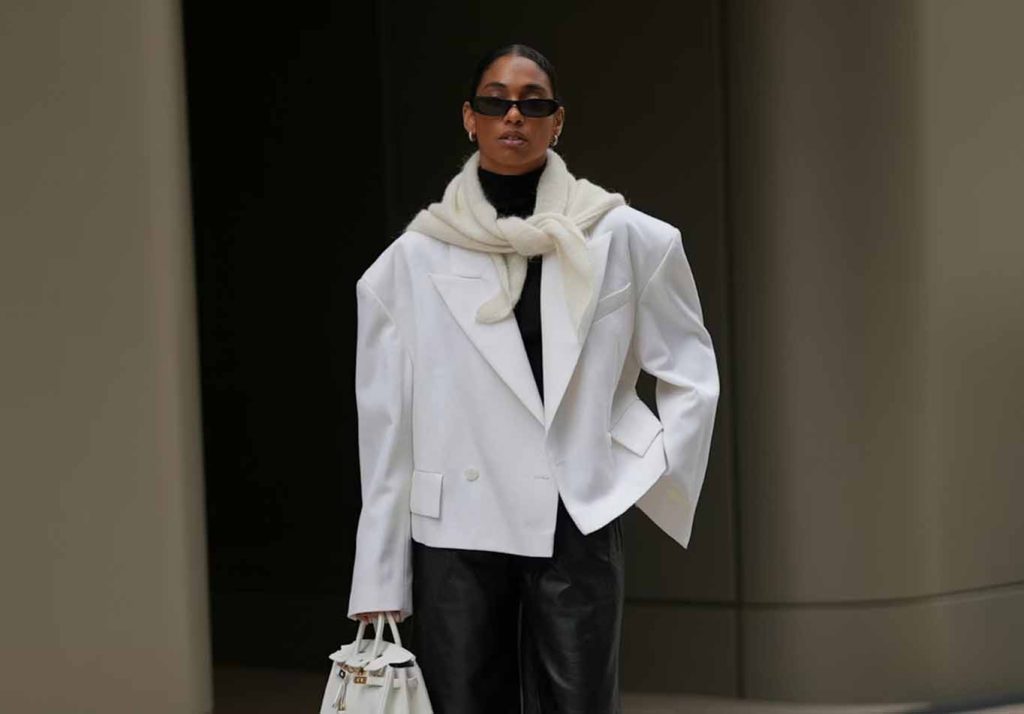
A Rational Foundation Piece
If you’re building a long-term scarf collection, ARKET is an excellent starting point.
Why It Works as a Base Item
- Clean design
- No unnecessary elements
- Mohair blend adds subtle texture
- Understated but refined
Its greatest strength is simple:
it never looks wrong.
Who It’s For
- First-time intentional buyers
- Those seeking minimal styling effort
- Value-conscious long-term wearers
Approximate price: €55
Available from: ARKET official website
Truly Versatile Scarves Are Chosen by Time
After many trials, I’ve settled on a simple but reliable rule.
A scarf worth investing in long-term usually meets these criteria:
- You reach for it on low-effort days
- You don’t abandon it when you change coats
- You instinctively grab it when you’re in a hurry
In autumn/winter 2025, scarves are no longer just about looking good. They are companion pieces—shaped by your habits, your environment, and your daily rhythm.
The best scarves may not be the most fashionable, but they withstand repetition.
When you reach for one without hesitation on a cold morning—when it blends seamlessly with every coat you own—its value has already been proven by time.